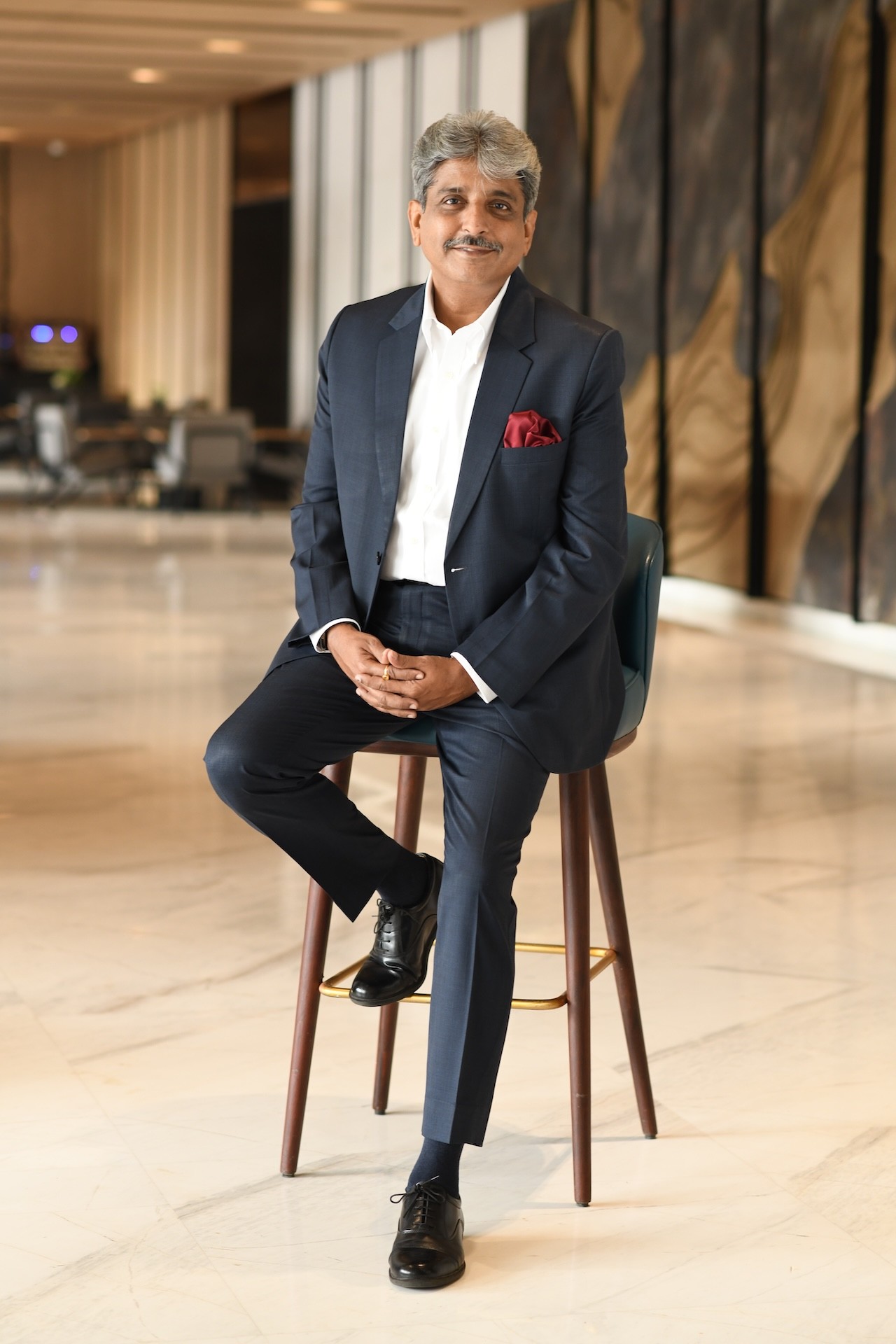
Mr. Deepak ThakurMD & CEO
Mr. Deepak Thakur is the Managing Director & CEO of Hinduja Renewables Energy Private Limited, where he leads the Hinduja Group’s clean energy vision, business and long-term expansion in India’s renewable energy landscape. With over three decades of leadership experience across energy, infrastructure, industrial products, and electronics, he brings a strong track record in corporate strategy, renewable energy development, EPC, operations, and enterprise-wide transformation.
Prior to joining the Hinduja Group, he was the Managing Director & CEO, at Mahindra Susten, where he was responsible for evolving the strategic direction, delivering business through organizational capability enhancement appropriately complimented by investments & collaborations.
Additionally, he has held senior leadership roles at respected organisations such as Reliance, Sterling & Wilson, Honeywell and Larsen & Toubro, among others. He has built and scaled businesses across diverse markets, overseeing strategy, sales, marketing, business planning, and large project execution.
A committed advocate for clean energy and sustainability, he has played a significant role in shaping India’s energy landscape, including contributing to the formulation of the National Solar Mission in 2009. He has also led global expansions, M&A, joint ventures, and technology partnerships across India, the US, Europe, the Middle East, Africa, and APAC.
DOMAIN / SECTOR (TO CAPTURE CURRENT SECTORAL TRENDS / DEVELOPMENTS / CHALLENGES)

1. What are the key challenges your organization is facing? Both immediate and long term. And what steps are you taking to overcome them?
India’s renewable energy sector is at a very exciting stage, and fortunately demand for energy is not the challenge, system integration is.
In the short term, the biggest challenges are largely execution-led: transmission and grid evacuation constraints, demand-supply mismatches, delays in PPAs/PSAs, regulatory flux, and land acquisition/local clearances. These issues are interlinked, and together they can significantly impact timelines, capacity creation, and project viability.
Our response is centered on disciplined execution and risk management – from careful site selection and tighter contracting structures to proactive engagement with transmission entities, portfolio diversification, and stronger post-commissioning operational controls.
Over the long term, the challenge becomes more structural. As renewable penetration increases, the system must evolve from conventional baseload thinking to one that can handle variability, intermittency, and peak-driven demand. In that context, I see three key long-term challenges: integrating storage and hybrid resources at scale, evolving grid infrastructure and market mechanisms to support a higher share of renewables and reducing supply chain risks by strengthening domestic manufacturing and supply capabilities.
Our long-term response is focused on building hybrid and firm renewable energy portfolios, rather than standalone generation assets. We are moving toward managing generation, storage, forecasting, and dispatch at a portfolio level, while aligning development and procurement more closely with domestic manufacturing and leveraging digitalization to improve asset resilience.
At Hinduja Renewables, one of the shifts I have been reinforcing is moving away from a “building megawatts” mindset toward a portfolio and platform mindset – where generation, storage, dispatch, and risk management work together to deliver dependable outcomes, not just installed capacity.
2. How has technology/globalization/economy affected your sector?
Technology has fundamentally reshaped the renewable energy industry. What was once a policy-driven sector is now increasingly a viable and mainstream power source. Advances in solar module efficiency, wind turbine design, and storage technologies are not only bringing costs down, but also improving predictability, reliability, and commercial viability. Storage has also moved from being peripheral to becoming central to system design, enabling the shift from intermittent renewable energy to firm and dispatchable solutions. In that sense, renewables are moving from being a supplementary source of power to becoming a core part of the system backbone.
Globalization has undoubtedly accelerated the sector’s growth by enabling access to global supply chains, advanced technologies, EPC expertise, and international capital. At the same time, recent geopolitical and trade disruptions have highlighted the importance of building domestic manufacturing capacity and greater supply chain resilience.
There is also a broader global influence through climate commitments. National net-zero targets, India’s decarbonization roadmap, and growing sustainability mandates by the industry have made renewable energy a strategic necessity for governments, utilities, and businesses alike, while also driving stronger investor interest in clean energy assets aligned to long-term climate goals.
From a macroeconomic perspective, India’s structural growth in electricity demand remains a strong tailwind particularly from commercial and industrial customers and emerging segments like data centres.
At the same time, the global capital environment has become tighter, which means the sector is moving away from a “growth at any cost” mindset toward greater emphasis on capital discipline, risk-adjusted returns, and long-term asset performance – a reflection, in many ways, of the sector’s growing maturity and institutionalization.
PEOPLE ASPECT

3. What is your talent strategy? How do you draw a balance between home grown vs lateral hiring at the leadership level?
Our talent strategy is anchored in capability-led growth. At this stage of our journey, we are focused on building the right leadership and functional depth to support scale, which means we are currently leaning more toward best-in-class lateral hiring. The objective is to bring in specialized expertise, fresh thinking, and operating know-how – not just from renewable energy, but also from adjacent sectors that can enrich the ecosystem we are building.
That said, lateral hiring is only one side of the equation. We are equally focused on identifying high-potential internal talent and investing in their development through customized growth interventions and leadership transition planning. So, for us, it is not really a choice between “build” or “buy” – it is about getting the balance right.
Lateral talent may help us accelerate and scale in the present, however, our long-term strength will come from the internal leaders we are grooming for the future. That philosophy sits within what we call our Capacity-Capability-Culture framework or the 3C framework, which is designed to blend fresh thinking and external expertise with our institutional values and group
ethos.
4. How are global shifts in technology/digitisation and customer preferences impacting your business and industry?
I prefer to use the term digitalization rather than digitization, because it reflects a much deeper transformation.
Digitalization is fundamentally redefining how renewable energy assets are operated and how customers evaluate value from these assets. What was once largely an asset-led business is now becoming far more data-driven and system-oriented, with tools such as advanced SCADA, AI led forecasting, centralized scheduling, and digital twins enabling better real-time decision
making, forecasting accuracy, and portfolio optimization. At the same time, customer expectations have evolved significantly. Power procurement is no longer just about buying megawatts – it is increasingly about buying outcomes.
Today, utilities, C&I customers, emerging sectors such as green hydrogen and green ammonia are looking for reliable, time-aligned, and predictable renewable energy supply, not just aggregate green power. This shift is driving demand for FDRE, RTC, and assured peak power, where the obligation is defined not just by how much capacity is installed, but when power must be delivered.
As a result, developers are moving toward more integrated, customer-centric energy solutions, where generation, storage, forecasting, and dispatch must work together. In that sense, digitalization is no longer just an efficiency lever – it is becoming central to how value is created and delivered.
5. Have there been any recent initiatives to upskill talent at the leadership level?
Yes, absolutely – and for us, leadership development is not a standalone HR initiative – it is closely tied to culture, alignment, and organizational effectiveness.
At the center of this is something I call the CEO Compass, which is how I stay connected across the organizational pyramid and ensure that people feel aligned to the company’s purpose, direction, and goals while also having a genuine opportunity to be heard. A key part of this is making sure that people’s voices are captured. Informal conversations only create value when they reach the people who can act on them.
To support this, we have built a few structured forums:
- Quarterly Town Halls: These are open forums where I share business context, organizational direction, and current priorities. Importantly, the Q&A is completely open and uncurated, which helps reinforce a culture of authenticity and transparency
- EVOLVE Sessions – This stands for Excellence, Vision, Openness, Learning, Value, and Empowerment. These are one-on-one conversations I have with identified employees – often at N-2, N-3, or even N-4 levels – where the discussion is not about the job or the business, but about the individual’s journey, aspirations, and perspectives. These conversations offer a powerful way to understand people more deeply and build leadership connection
- VIBE Sessions – This stands for Voice, Insight, Belonging, and Energy. These are skip level group interactions where teams can openly discuss what is working, what is not, and ideas they would like to share with respect to process or business
- Monthly leadership huddles: These bring together my direct leadership team and select next-line leaders to discuss matters that are strategically important to the business, including key decisions and action planning
- Ground-Level Engagement: During site visits, I also make it a point to connect directly with teams on the ground so that I can get closer to the real operating environment, rather than a curated version of it
Alongside this, we also run technical and functional upskilling, leadership coaching, executive coaching, and individual development initiatives. The philosophy is simple: we do not want tick-box initiatives. Every intervention must be meaningful and must help people grow in a way that genuinely supports both the individual and the organization.
LEADERSHIP

6. Is the pursuit of innovation a constant or a situational strategy? Please elaborate with examples.
For me, innovation is not situational – it is a necessity and a way of life.
If an organization keeps doing things exactly the way its peers do, the likely outcome is mediocrity. Whether you call it innovation or simply doing things differently, the point is the same: if you want to outperform, you cannot rely on copy-paste thinking or business-as-usual approaches.
I strongly believe in a simple philosophy – to win, we do not need to be dramatically better than everyone else; we need to be 1% better across everything we do. That could mean how we think about tariffs, cost structures, system design, people practices, execution models, or operating approaches. Over time, those marginal improvements create real differentiation.
Innovation has two dimensions. The first is greenfield, where you have the flexibility to build from ground up. The second – and more realistic – is the brownfield reality, where you are working within constraints such as legacy systems, existing business models, and committed capital. That is where innovation becomes more important because it is about creating value within constraints.
This is where people become the differentiator. Innovation happens when there is ownership, no silos, and ideas can come from anywhere, not just hierarchy. That is when it moves beyond technology and becomes part of culture.
In my view, innovation is not a department – it should seep through the organization, whether in system design, execution, or operations. It also requires room for experimentation. You cannot expect every attempt to succeed, but within defined boundaries, people should feel confident taking calculated bets. That is what drives long-term differentiation.
7. As an organization’s leader, how do you prepare your teams to navigate nonlinear situations / decisions?
It starts with clarity. If people are clear about the organization’s short, medium, and long-term goals, and if those goals are tangible, then people at every level are better equipped to make decisions, even in uncertain or nonlinear situations. The real test is whether someone on the ground can connect their actions to those broader organizational goals. When that happens, decision-making becomes much more aligned and much more confident. The real test is whether someone on the ground can connect their actions to broader organizational goals and when that happens, decision-making becomes far more aligned and confident.
The second important element is communication, and I would say there is no such thing as over-communication, provided the messaging is consistent and coherent, and aligned across leadership levels.
The third is empowering people to take decisions. I strongly believe that in many situations, not taking a decision is not an option. In nonlinear environments, waiting for perfect information often comes with a cost. That becomes especially important because nonlinear situations, by definition, do not come with a playbook. They require judgment, adaptability, and human instinct – capabilities that cannot be replaced by AI.
The final piece is building a culture of cross-functional collaboration and shared ownership. Teams should not wait for a crisis to start working together. That mindset must exist beforehand.
As leaders, we cannot solve every situation ourselves – but we can create the clarity, culture, and confidence that help teams respond well when complexity shows up.
PERSONAL

8. What are the 3 most pivotal moments in your career that you learned from and/or that got you where you are today?
The first pivotal moment was at the very beginning of my career, when I chose not to settle for the job offer I had through campus placements. I am an engineer and an MBA, and I wanted a role that would allow me to use both skill sets. I was very clear in my mind that I wanted to work with Larsen & Toubro. So instead of accepting what was available, I went beyond the campus process, approached L&T directly and after multiple rounds of interviews, eventually became part of their first batch of Management Trainees. That experience taught me the importance of backing your conviction and not simply accepting the hand you are dealt.
The second came during my time at Thermax, where I moved from a strategy and planning role into a more operating and business-led responsibility. That shift helped me move from thinking about business from a strategic lens to someone who was also accountable for delivering outcomes on the ground. It also taught me that leaders often take bets on potential before performance catches up. The MD designate then, took the chance of giving me a channel business leader role which I conventionally did not fit into.
The third was during my time Sterling & Wilson, when we had to make the very difficult decision to shut down one of the verticals I was leading. It was a deeply challenging moment because it impacted people directly. It would have been easy to let the process be handled impersonally, but I strongly felt that if I was responsible for the decision, then I needed to look people in the eye and communicate it myself. That experience reinforced my belief in a people-first leadership approach. Leadership is not only about making difficult decisions – it is about how you show up when those decisions affect people’s lives.
Those experiences, though very different from one another, collectively shaped my leadership philosophy – to back conviction with action, to create opportunities rather than wait for them, to trust potential even before it is proven, and to lead with empathy and accountability, especially in the moments that matter most.
9. What message would you like to share with young professionals?
There are three things I would say to young professionals.
- The first is: be a sponge. Absorb as much as you can – not just technical knowledge, but also how people think, communicate, make decisions, and solve problems. When you get the opportunity to sit in meetings, be part of discussions, or observe how people think and operate – pay attention.
- The second is: seek work. Early in your career, your ability to learn, absorb, and stretch is at its strongest. Do not just wait to be given opportunities – actively seek them out. Listening is important, but doing is what accelerates learning.
- And the third is: bring positive energy. Workplaces today can often feel intense and overloaded. I think young professionals have a real opportunity to bring in more lightness, positivity, and human warmth while still being serious about performance.
So, if I had to summarize it simply, I would say: absorb deeply, do proactively, and bring positive energy wherever you go.